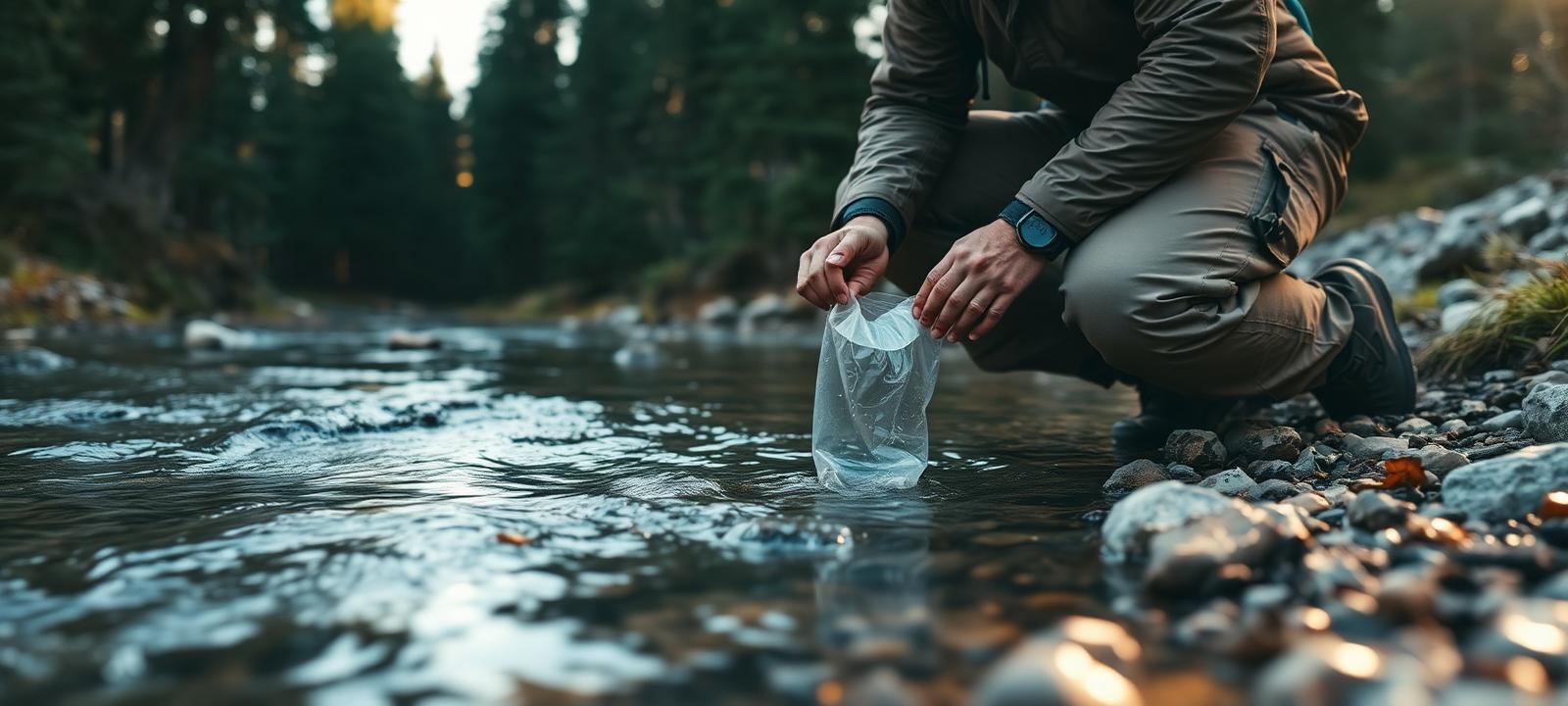
Camp Skills
Water treatment
Assume every natural water source needs treating, however clear and cold it runs. This is the organized version: what's actually in wild water, how each method compares, which one fits your trip, and the numbers you need to plan around.
What you're treating for
What's actually in wild water
Six categories, and they don't all respond to the same treatment. Knowing which ones you're facing is what makes the method choice obvious.
Protozoa — Giardia, Cryptosporidium
The most common cause of backcountry illness in North America. Big enough for any filter to catch, but Cryptosporidium shrugs off chlorine and iodine almost entirely. Symptoms appear 1–3 weeks later.
Bacteria — E. coli, Salmonella, Campylobacter
Caught by filters, killed by boiling and by every chemical treatment. Concentrations spike downstream of livestock, pack stock and heavy human use.
Viruses — Norovirus, Hepatitis A
Too small for standard hollow-fibre filters. Rare in remote North American backcountry, a genuine risk internationally and near heavy human contamination. Purifiers, UV and chemicals handle them.
Sediment and turbidity
Harmless itself, but it clogs filters within hours and physically shields pathogens from chemicals and UV light. Cloudy water always gets pre-filtered and settled first.
Chemical contamination
Mine tailings, agricultural runoff, road salt and heavy metals pass straight through every backpacking filter. No field method removes them — the only defence is choosing a different source.
Cyanobacteria (blue-green algae)
Green paint-like scum on warm, still water in late summer. The toxins are not removed by filters or chemicals and are dangerous to dogs. Never collect from a bloom, at any distance.
Clear water is not clean water
Interactive
Find your treatment method
Answer five questions about the trip and get a primary method, a backup, and the reasoning behind both.
Recommended setup
Hollow-fibre squeeze filter
The default choice for solo hikers and pairs in North America.
Strengths
- + Instant, no wait time
- + 2–11 oz and cheap
- + No taste, no chemicals
Trade-offs
- – Does not remove viruses
- – Destroyed by a single freeze
- – Flow drops as it clogs
Carry as backup: Chlorine dioxide
- • Clear North American water, small party — a hollow-fibre squeeze filter is instant and hard to beat.
- • Pair it with chlorine dioxide tablets: an ounce of insurance that covers clogs, cracks and freezes.
Compared
Every method, side by side
Seven approaches. Most campers end up with two: one fast primary and one bombproof backup.
Hollow-fibre squeeze filter
The default choice for solo hikers and pairs in North America.
Gravity system
Hang the dirty bag, walk away, come back to litres of clean water.
Pump filter
For shallow seeps, silty tanks and awkward sources a bag can't scoop.
Chlorine dioxide
The weightless backup that belongs in every pack lid, forever.
UV pen
90 seconds per litre in clear water, viruses included.
Boiling
The fallback that always works if you have fuel.
Purifier (virus-rated)
Filtration plus a virus barrier for international and high-use water.
| Method | Protozoa | Bacteria | Viruses | Speed | Weight | Best for |
|---|---|---|---|---|---|---|
| Hollow-fibre filter | Yes | Yes | No | Instant | 2–11 oz | Solo and pairs, North America |
| Gravity system | Yes | Yes | No | 6 L / 10 min | 12 oz | Groups and basecamps |
| Pump filter | Yes | Yes | Some models | 1 L / min | 12–20 oz | Shallow or silty sources |
| Chlorine dioxide | Yes (4 hr) | Yes | Yes | 30 min – 4 hr | 1 oz | Backup, ultralight |
| UV pen | Yes | Yes | Yes | 90 sec / L | 5 oz | Clear water, international |
| Boiling | Yes | Yes | Yes | Fuel + cooling | Stove only | Winter, emergencies |
| Purifier | Yes | Yes | Yes | Near instant | 12–16 oz | International travel |
Reference
Dosing and boil times
Boil times by elevation
| Elevation | Rolling boil hold | Notes |
|---|---|---|
| Sea level – 6,500 ft | 1 minute | Reaching a boil does most of the work; the hold is margin. |
| Above 6,500 ft / 2,000 m | 3 minutes | Lower boiling point means less thermal kill per second. |
| Melted snow | 1–3 minutes | Snow is not sterile — treat it exactly like surface water. |
Chemical contact times
| Treatment | Bacteria & viruses | Giardia | Cryptosporidium | Cold water |
|---|---|---|---|---|
| Chlorine dioxide tablets | 15–30 min | 30 min | 4 hours | Roughly double all times |
| Chlorine dioxide drops | 15–30 min | 30 min | 4 hours | Roughly double all times |
| Household bleach (unscented) | 30 min | 30 min | Not effective | Double, and add a second dose |
| Iodine tablets | 30 min | 30 min | Not effective | Double; not for pregnancy or thyroid issues |
Always follow the dose printed on your product. Chemicals need clear water — pre-filter and settle anything cloudy first, because particles physically shield pathogens from both chemicals and UV.
Half the battle
Choosing and collecting from a source
A good source makes every treatment method faster, cleaner and longer-lived. A bad source ruins a cartridge in an afternoon.
- 1
Prefer moving water over standing
Springs and streams over ponds and puddles. Flow dilutes and flushes; still water concentrates everything and warms into algae territory.
- 2
Go upstream of use
Above campsites, trails, grazing, mines and any road crossing. Half a mile upstream is a genuinely meaningful difference.
- 3
Read the drainage above you
Look at the map before you look at the water. A clear creek below a pasture or an old mine is a bad source no matter how pretty it is.
- 4
Collect from the surface layer, gently
Scooping the bottom loads your filter with silt. Tilt a wide-mouth bottle just under the surface, or float a bandana-lined scoop.
- 5
Pre-filter anything cloudy
A bandana, coffee filter or the mesh bag the filter shipped in. This routinely doubles or triples cartridge life.
- 6
Let sediment settle
Twenty minutes standing drops most suspended silt out. Decant the clear top off and leave the last inch behind.
- 7
Keep clean and dirty strictly separate
Colour-code bottles, never let a dirty spout touch a clean thread, and treat your hands as dirty until they're washed. Cross-contamination causes most 'the filter failed' stories.
Logistics
How much water you actually need
Water weighs 8.34 lb per gallon — 2.2 lb per litre. It's the heaviest thing you carry, which is exactly why planning it beats guessing.
| Total water needed | 33 L (8.7 gal) |
| Weight if you carry it all | 73 lb |
| Per person, per day | 5.5 L |
| Minimum clean capacity to carry | 4 L |
Estimates for planning only. Car and RV campers should carry the full amount from home where possible; backpackers should treat these numbers as the volume to source and treat along the route.
Never plan on a seasonal source
By camping style
Water strategy for how you camp
Tent and backpacking
One hollow-fibre filter plus chlorine dioxide tablets as backup. Plan the day around known sources, carry 1–2 L between them, and sleep with the filter in cold weather.
Car camping
Bring water from home in 5–7 gallon jugs — it's the cheapest reliability you can buy. A gravity bag handles top-ups from a campground spigot of unknown quality.
RV camping
White drinking hose only, an inline carbon filter at the spigot, a pressure regulator, and a bleach sanitising cycle on the freshwater tank twice a season.
Glamping and cabins
Ask whether the tap is potable and whether it's a well. Well water is usually fine but can be hard, sulphurous or seasonally contaminated after heavy rain.
Desert and heat
Double your planning volume, cache water at road crossings where legal, and never rely on a single seasonal tank without a recent report.
Winter
Melt snow rather than fight frozen sources; it still needs boiling or chemical treatment. Filters freeze and fail — chemicals and a stove are the winter pair.
Longevity
Looking after your filter
Backflush after every trip
Hollow-fibre filters recover most of their flow rate from a proper backflush while still wet. Dried-in silt is permanent.
Never let it freeze
Ice cracks the fibres invisibly, and the filter then passes everything while looking perfect. In cold weather it lives in your sleeping bag.
Dry fully before storage
Store dry and open. A damp sealed filter grows exactly what you bought it to remove. A capful of diluted bleach before drying is cheap insurance.
Track your volume
Cartridges are rated in gallons or litres. Log roughly what you've run through and replace on schedule, not on a hunch.
Check chemical expiry
Chlorine dioxide degrades in the packet. Replace your emergency tablets every season and after any wet trip.
Test at home
Run the filter in the kitchen sink before you leave. Discovering a cracked cartridge at the trailhead ends the trip.
In the field
When something goes wrong
Flow has slowed to a trickle
Silt in the fibres. Backflush hard, then agitate in clean water. If flow doesn't return, the cartridge is done — treat chemically and replace at home.
The only water is muddy
Settle it 20–30 minutes, pre-filter through cloth, then treat. If it stays turbid, boil rather than trusting chemicals or UV, both of which are blocked by particles.
The water is near-freezing
Chemical contact times roughly double below 10°C / 50°F. Warm the bottle inside your jacket, or double the wait.
Your filter froze overnight
Assume it's compromised. Do not gamble the trip on it — switch to boiling or tablets for the rest of the trip.
Treated water tastes awful
Aerate by pouring between bottles, add an electrolyte tab, or run it through a carbon element. Taste is not a safety signal either way.
Someone gets sick anyway
Isolate their utensils, push fluids and electrolytes hard, and sanitise hands relentlessly — most camp illness is fecal-oral hand transmission, not the water.
Pack it
Water kit checklist
Tick items off as you pack — your progress saves in this browser.
Primary treatment
Backup treatment
Collection & storage
Hygiene & extras
Car & RV
Questions
Water treatment FAQ
+Do I really need to treat clear mountain water?
Yes. Giardia has no taste, smell or visible sign, and symptoms show up one to three weeks later, long after you stop connecting them to the trip. Clarity tells you about sediment, not pathogens.
+How long do I have to boil water?
A rolling boil for one full minute at most elevations, three minutes above 6,500 ft / 2,000 m. Reaching a boil at all does most of the work — the hold time is the safety margin.
+Is a filter or tablets better?
Carry both. A filter is instant and tastes like nothing; tablets weigh an ounce, kill viruses, and keep working when the filter clogs or freezes. They cover each other's failure modes.
+Can any filter remove chemicals or heavy metals?
Not meaningfully in the field. Carbon elements improve taste and reduce some organics, but mining and agricultural contamination cannot be filtered out with backpacking gear. Choose another source.
+Is campground tap water always safe?
No. Read the signage — non-potable spigots exist for washing and flushing. Seasonal systems can also be shut down or unsanitised early and late in the year.
+How much water should I plan per person per day?
One gallon (about 3.8 L) per person per day for drinking and cooking, doubled in heat, at altitude or on hard-effort days, plus extra for dishes, washing and dogs.